
role
Reframed the first loan officer conversation and led a participatory design effort to build a lightweight affordability experience grounded in trust, clarity, and real-time decision support.
timeline
1 week
focus
system
Loan origination system
Loan point of sale system
tool
Figma
C
ontext
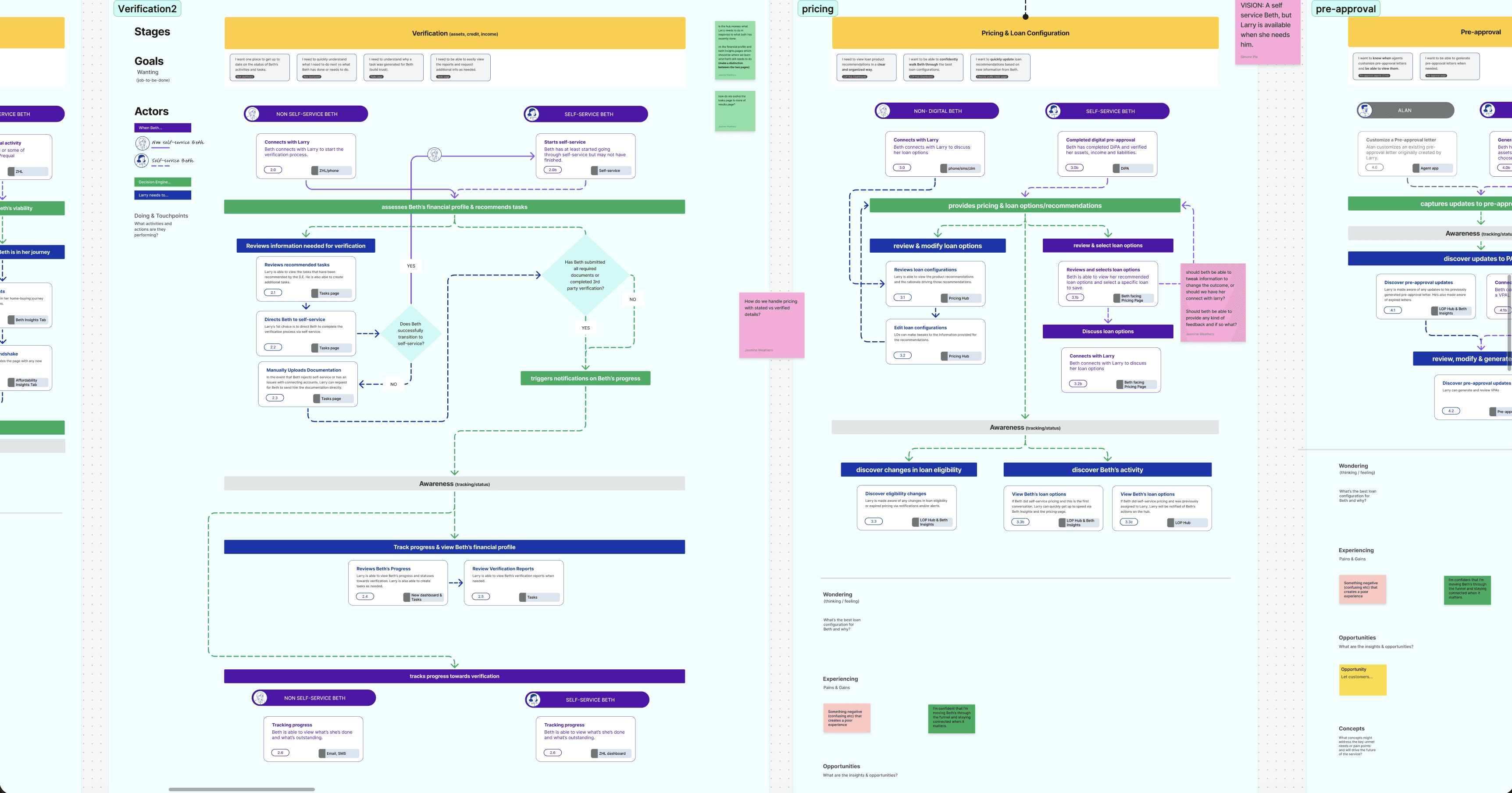
To understand how the system needed to behave, I stepped back from individual features and focused on user actions across the entire loan journey. Rather than mapping loan officer workflows in isolation, I created an end-to-end view that paired borrower behavior with loan officer actions, and examined how the system should respond to both over time.
The mapping accounted for two primary borrower patterns: borrowers who complete steps independently and borrowers who rely more heavily on loan officers for support. For each path, I outlined not only the actions taken but also how those actions should trigger system behavior such as verification, task creation, follow-ups, and recommendations, regardless of who initiated the step. This shifted the framing from who does what to how the system responds. Borrower behavior often became the driver, with the system interpreting inputs, progress, and inactivity to determine
what needs to happen next and what the loan officer should be prompted to do. Loan officer actions remained critical, but they were part of a broader adaptive loop rather than the sole source of system state.
By mapping behavior across every stage of the loan lifecycle, the flows made complex orchestration visible. They clarified how rules, triggers, and recommendations needed to work together to coordinate effort across borrowers and loan officers. They also exposed where manual judgment or ad hoc processes were carrying too much of the load.
The result was a shared mental model for how intelligence and automation should function within the platform. Not as a collection of disconnected features, but as a system that continuously interprets behavior and guides work forward.
Design
approach
The decision engine flows became a foundational reference point for the team. By grounding backend requirements in real user behavior, the mapping created a shared language for product and engineering to discuss system logic, automation, and ownership across the loan lifecycle.
For product leaders, the flows clarified what it actually means to support intelligent, end-to-end workflows. Conversations moved beyond feature lists and into discussions about orchestration, timing, and system response. For engineering, the diagrams connected implementation decisions back to concrete user actions, making it easier to reason about rules, triggers, and dependencies
without losing sight of the experience they were meant to support. More broadly, this work shifted how we approached system design. Instead of treating automation as a series of isolated enhancements, the Decision Engine reframed it as a behavior-driven system that continuously interprets signals from both borrowers and loan officers to guide work forward. That framing influenced later initiatives, including pricing and affordability, by establishing a clearer model for how intelligence and user control could coexist within the platform. The outcome was not just clearer documentation, but clearer direction. We aligned around a shared understanding of how the system should think, respond, and scale over time.
What this work shaped
Impact
PREVIOUS READ