
role
Explored how AI-driven recommendations and risk-free scenario building can help loan officers navigate complex pricing decisions while maintaining control.
timeline
focus
system
tool
C
ontext
Loan Officer Workflow
Discovery
Verification
Pricing
where trade-offs are weighed
Pre-Approval
Offer

The existing pricing table exposed the full breadth of options, but it did little to help loan officers determine which scenario was actually best for a given borrower. Identifying the right option depended heavily on the loan officer’s experience, the complexity of the borrower’s financial profile, and the loan officer’s understanding of the trade-offs between different loan details.
At the same time, loan officers were often modifying live loan
applications simply to explore possibilities. These exploratory changes introduced risk, especially when values were not properly reverted before underwriting or closing.
The challenge was not just about usability, but about how loan officers could move from complexity to clarity at the moment a decision needed to be made, without losing control or confidence in the process.
Problem
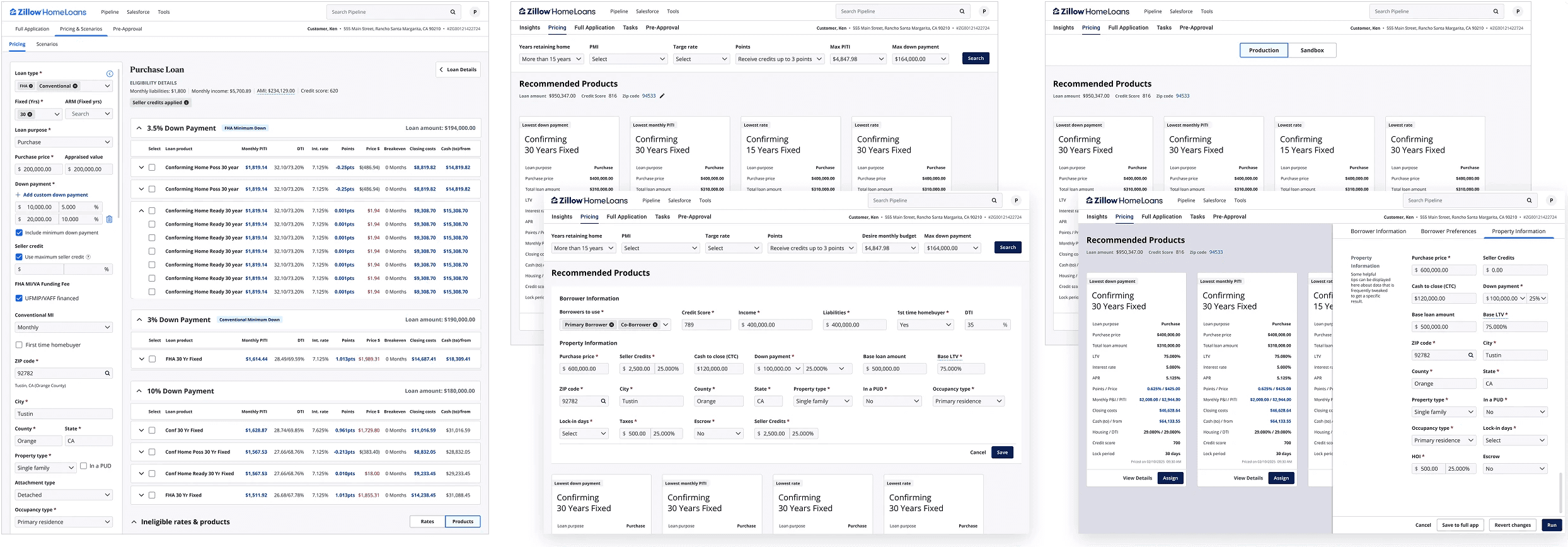
Rather than starting from a single solution, I framed this work as a way to probe boundaries and understand how far the experience could move away from the traditional pricing table without breaking trust or control.
I explored a range of concepts that intentionally varied in how closely they stayed tied to the existing table. On the conservative end, this meant enhancing the pricing table by surfacing borrower preferences and the small set of levers loan officers already tend to
adjust. Moving further, I explored whether the system could surface recommended scenarios based on the borrower’s financial profile, shifting the pricing table into a secondary role.
This framing allowed me to test readiness. How tied were loan officers to the pricing table as a starting point? What information did they need to feel confident? And how much structure could the system provide before it felt prescriptive rather than supportive?
Design
approach
Balancing automation and control
The intent was not to reduce choice across the system. Instead, the goal was to reduce the complexity of choosing the best loan scenario and provide meaningful value at the moment decisions were being made.
Design
intent
That meant:
Helping loan officers quickly orient themselves to viable options
Supporting reasoning about trade-offs and downstream impact
Preserving loan officer autonomy and judgment
Recommendation-first pricing
Rather than requiring loan officers to start with an overwhelming pricing table, the concepts explored a recommendation-first approach. The system could surface a small set of scenarios based on a borrower’s financial profile and preferences, helping loan officers focus on the most relevant options first.
Each recommendation included plain-language explanations that loan officers could use directly or adapt when speaking with borrowers. This helped bridge the gap between system logic and real-time conversation, especially in more complex financial situations.
Sandbox exploration
Recognizing that the system could only operate on the information it had, the sandbox allowed loan officers to adjust key inputs and explore how changes would affect recommendations without modifying the live loan file.
Loan officers could:
Tweak the variables they already adjust in practice
Compare updated scenarios side by side
Save, discard, or promote scenarios intentionally
Apply changes to the loan file only when ready
Solution
This work helped determine the right pace of change toward a recommendation-first pricing experience. Rather than jumping straight to an ideal future state, the explorations clarified what incremental steps could build credibility and trust over time, and what level of structure, explanation, and flexibility was needed at each stage.
Loan officers responded most positively to recommendation-first concepts when paired with explainability and control, particularly in complex scenarios where borrower situations were borderline or nuanced, such as self-employment or mixed income sources. In more straightforward cases with clear-cut financial profiles, loan officers often described the recommendations as “duh” moments and saw less added value.
Overall, the concepts explored through this work helped align product, design, and engineering around a shared vision for the future of pricing.
“This eliminates the guessing game and trying to figure out, okay, based off their credit profile, what loan program would they be eligible for.”
“This opens opportunities to de-risk disqualifying borrowers by making temporary changes in the 1003 and improve the LO workflow.”
What this work shaped
Impact